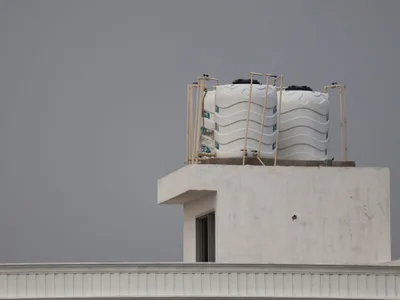
What settles inside a rooftop tank over time
Sediment is mineral particles that travel with mains water. When water sits in the tank, these particles drift down and settle on the base, compacting over time into a pale, fine layer that can coat the entire floor. In a coastal, humid climate, fluctuating water temperatures cause minerals to drop out of solution faster than they would in cooler, drier conditions. This is a slow, invisible process. A tank can hold a visible sediment layer and still deliver water that looks clear, because the outflow pipe draws from a point higher up, well above the settled material on the floor. The sediment carries on building whether the household notices it or not.
Biofilm forms where cleaning has never reached
Biofilm is a community of microorganisms, mostly bacteria, that attach to a surface and surround themselves with a thin, slimy layer they produce themselves. Inside a water tank, the walls and underside of the roof provide that surface. Biofilm does not look like contamination in the way mould does. It can be nearly transparent, pale grey or slightly waxy, and it adheres rather than floating freely. Because it clings to surfaces rather than circulating, it does not show up in water poured from a tap. Scrubbing removes it mechanically, but sterilisation is needed afterwards to address what the scrubbing brush cannot reach in textured welds and corners. A tank that looks clean to a torch shone through the hatch can still be coated below the waterline.
The hatch view shows almost nothing useful
The hatch sits at the top of the tank, which means anyone looking in sees the water surface and, if the tank is low, the top few centimetres of the walls. The base of a full tank is invisible. The walls below the waterline appear only as reflections on the water surface. Sediment sitting on the floor is several metres below the opening and hidden by the water column above it. Biofilm on the lower walls can only be identified at close range on an emptied tank. A tank that passes a quick visual check at the hatch can still have a fouled base and coated walls. The check tells you very little about the condition of the interior.
What the household notices before the hatch opens
Sediment that has built up over time can be disturbed by a change in water pressure or a sudden draw-off from several taps at once. When that happens, fine particles enter the supply. They are most obvious at the bottom of a clear glass, or as a pale residue around a tap outlet. A kettle base that scales faster than usual, or a sediment filter that needs replacing sooner than expected, can point to the same source. Hot water can carry a faint mineral or stale smell when it is first drawn, because heat drives off dissolved gases that cold water holds in suspension. These signs are easy to attribute to the pipes or the mains supply, but the tank is often the origin.
Cleaning frequency depends on conditions, not a calendar
A household that draws from the tank heavily and refills it frequently gives sediment less time to compact, but also introduces more particles with each fill. A tank that is large relative to the number of people using it will have water sitting longer between refills, which allows whatever has settled to consolidate undisturbed. The material the tank is made from affects how easily biofilm adheres to the surface. Whether the access hatch fits properly determines how much airborne dust and insects can enter over time. In a humid, coastal climate, condensation on the interior walls can encourage biofilm growth even when the tank is used regularly. The right interval is not a fixed number of months. It is an answer to several questions about the specific conditions inside that particular tank.