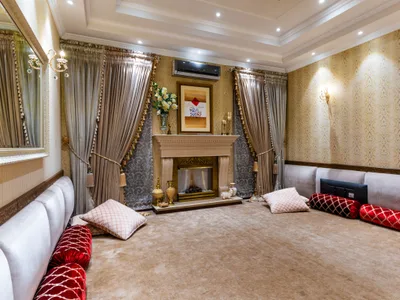
Floor seating meets dirt from every direction
Western furniture sits on legs. The fabric of a sofa's seat and back faces upward and forward, away from the floor. Majlis seating sits on the floor itself, or rises only a few centimetres above it. That position means every cushion, bolster and base pad is in direct contact with the surface where dust settles heaviest and, in a coastal climate, where floor moisture works its way upward through the day. A vacuum lifts what rests on the surface fibres, but the bulk of what accumulates in floor-level seating has worked down into the padding. The visible surface can look clean while the interior is loaded with what settled and compacted over months of gatherings.
Natural dyes do not forgive a wrong method
A handmade rug is not dyed with the industrial pigments used in machine-made carpets. Many traditional rugs use natural dyes, plant-based compounds that fix to the wool or silk fibre through a mordant process. Those dyes are sensitive to pH, to water temperature and to how long moisture sits in the pile. A rug that has borne foot traffic and decades of use without losing its depth of colour can bleed, streak or fade in a single wash if the water is the wrong temperature or if the method holds moisture against the pile for too long. The structure of the fibre also determines the right approach. Wool, silk and cotton absorb and release moisture at different rates, and cleaning something as if it were something else is where the damage starts.
Padding holds what a vacuum cannot reach
Dust mites live in the padding of upholstered furniture, not on its surface. A detergent applied to the surface fabric cleans the fibre it touches but has no mechanism for reaching what lies beneath. Hot-water extraction works differently. It forces water and a cleaning solution into the padding at pressure, then draws both back out, carrying with it the material that has settled into the interior. The heat is part of what makes this effective against dust mites specifically, because heat kills them where they live. Surface cleaning cannot substitute for this because it never reaches the interior. Running a brush or a spray across the top of a majlis cushion addresses the face of the fabric and nothing else.
Moisture left behind returns on a humid day
The coastal climate here is specific in one way that matters for textile cleaning. Humidity does not stay constant across the day or the season, and fabric that retains moisture after a clean will release it into the air as the humidity rises. A cushion that feels adequately dry and smells clean in the middle of a warm afternoon can carry an odour by the following evening when the air thickens. The problem is not the cleaning agent; it is the extraction. If the machine draws moisture back out of the fabric, it removes the source. If it leaves moisture in the padding, the only question is when the smell returns, not whether it does. A correct clean should leave the textile dry, not merely damp.
The order of cleaning is not optional
A room full of textiles has to be cleaned in sequence, because each stage can re-soil what came before it. Dry work, vacuuming and dusting, has to finish before any wet method is introduced. The rugs and the seating cushions cannot be cleaned at the same time, because moisture migrates. An area rug sitting beside a wet cushion will absorb what drips from it. Within the rug itself, the pile must be dried in the right orientation, because pile that dries against itself can mat or lose its set. The sequence is not a matter of preference; it follows the physics of how moisture moves through fabric and how soils transfer. Treating it as optional is what turns a single cleaning session into two problems instead of one.